
American Mahjong Strategy for Beginners: Better Decisions One Turn at a Time
American Mahjong strategy for beginners is less about finding a clever trick and more about making fewer rushed decisions. A player improves by reading the card carefully, noticing what the table reveals, passing with purpose during the Charleston, and changing direction before a hand becomes impossible. This guide turns those ideas into a practical review routine for home games, lessons, and weekly groups using JOKKOL equipment.
Start with the card, not the prettiest tiles
At the beginning of a round, scan the current card for patterns that resemble your tiles. Count the structure of each possibility: pairs, sequences, groups, and any special requirements. A hand that looks colorful may have no realistic path, while an ordinary-looking group may fit a pattern with fewer changes.
Write down two or three candidate hands in plain language. For example, “a pair-heavy line with one Joker” is easier to remember than trying to hold the whole card in your head. Recheck the line after each pass and discard.
Use the Charleston to test a direction
The Charleston is a chance to improve a hand and learn what the table is not protecting. Pass tiles that do not support either of your strongest candidate hands. Avoid sending away a useful pair simply because another tile looks more interesting.
During the first pass, favor clarity over perfection. If the hand has no direction after the next pass, that is information. A player who notices early can change hands with less waste than someone who waits until the wall is nearly gone.
Watch the table without guessing too much
Discarded tiles tell you something, but not everything. A tile that appears twice may be unwanted, or it may be safe only because another player is pursuing a different pattern. Use visible information as a clue, not a guarantee.
Keep a small mental list:
- Which tiles from your candidate hands have already appeared?
- Which suits does each player seem to be collecting?
- Has a needed pair become less likely?
- Did a Joker appear in an exposed grouping?
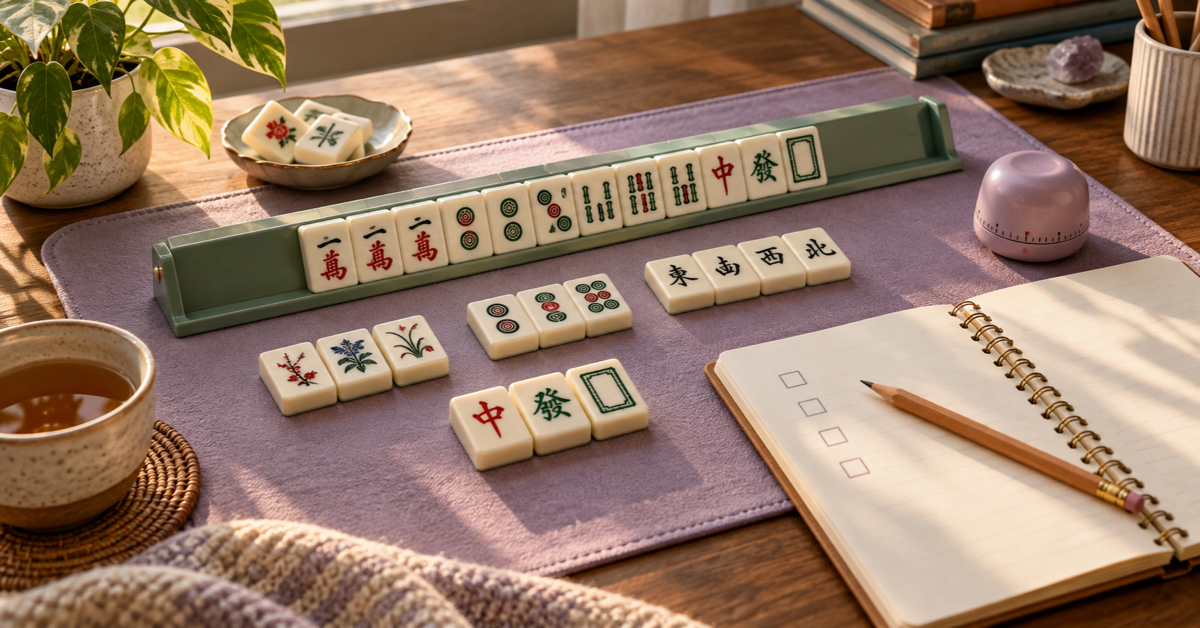
The rack helps here. When the hand remains grouped by suit and special tiles, changes in your plan are easier to see.
Treat Jokers as flexibility, not permission to stop thinking
Jokers can keep a promising hand alive, but they do not solve every structural problem. Before holding a Joker, ask what it is supporting and whether the rest of the pattern can realistically arrive. A Joker with no clear job can hide a weak plan.
If your rules allow a Joker exchange from an exposed group, learn that procedure before relying on it. Call the action clearly and follow the group's order. Strategy is useful only when the table agrees on the rule being used.
Know when to change hands
Changing hands is not failure. It is a decision based on evidence. Consider a switch when:
- Several required tiles have already appeared in discards or exposed groups.
- You still need multiple pairs with few draws left.
- The hand depends on a Joker you do not have and cannot reasonably replace.
- A new set of tiles now supports a simpler pattern.
Do the comparison before discarding: what you keep, what you need, and how many chances remain. A short pause is often better than defending a plan because you started with it.
Separate offense from table etiquette
Good American Mahjong strategy for beginners includes clear table behavior. Announce a call, wait for the correct player to continue, and keep exposed groups visible. Do not touch another player's rack or rearrange the wall without agreement. A calm table gives everyone more accurate information.
When teaching, explain the reason for a decision after the turn rather than criticizing it during the turn. Players learn faster when they can connect the choice to the card and the visible tiles.
A solo practice method
You can practice without a full group:
Card scan
Choose one line from the card and build a sample hand from the set. Set aside the tiles that would complete it. This develops recognition without the pressure of a live round.
Discard review
Lay out a pretend discard row and ask which candidate hand still has a path. Remove one required tile at a time. The exercise teaches you to notice when a plan is becoming narrow.
Charleston rehearsal
Deal a small group of random tiles, sort them, and choose a pass in under one minute. There is no need to score the hand. The goal is to make a reasoned pass without freezing.
A readable mat, stable racks, and pushers that match the tile size make solo practice closer to a real table routine.
A weekly improvement loop
After each game, write three notes:
- One decision that improved the hand
- One point where you waited too long to change direction
- One rule or pattern to review before next week
This is more useful than trying to remember every discarded tile. Over time, the notes reveal your actual habits: holding a weak pair, passing too conservatively, or ignoring what the table is showing.
JOKKOL's American Mahjong collection includes colorful tile sets, racks, pushers, dice, mats, and a rulebook for a consistent practice table. For questions about matching sizes or a custom setup, contact JOKKOL.
FAQ
What is the most important American Mahjong strategy for beginners?
Read the card before choosing a direction, then revisit the plan after the Charleston and each important discard.
What tiles should I pass in the Charleston?
Pass tiles that support neither of your strongest candidate hands. Keep useful pairs and tiles that can serve more than one realistic pattern.
When should I change hands?
Change when key tiles are already visible, too many pairs are still missing, or another pattern now has a clearer path.
How can I practice American Mahjong alone?
Rehearse card scans, discard reviews, and timed Charleston passes with a set of tiles and the current card.
Is American Mahjong strategy different from general Mahjong strategy?
Yes. American play uses its own card, Charleston, Joker conventions, and table habits, so advice should match the version you play.