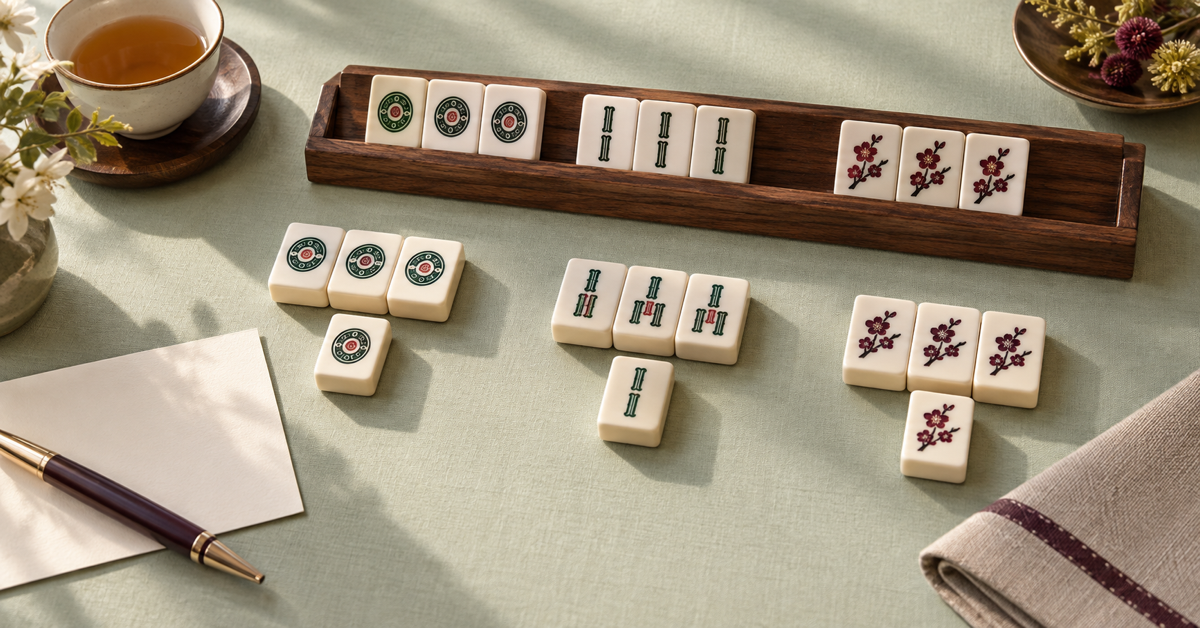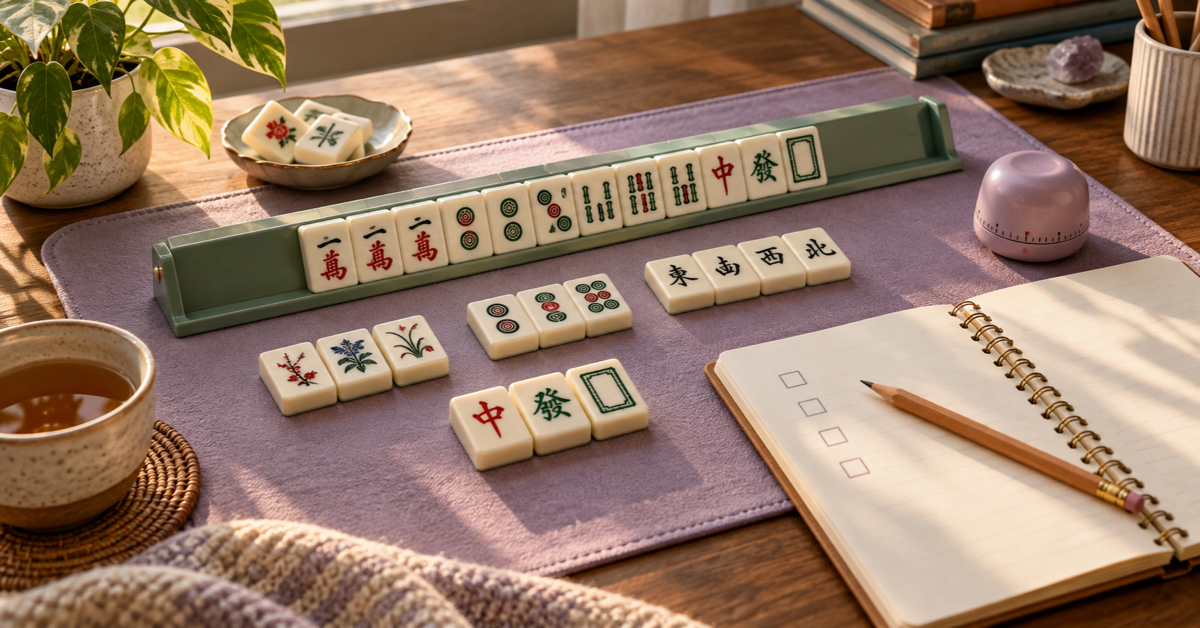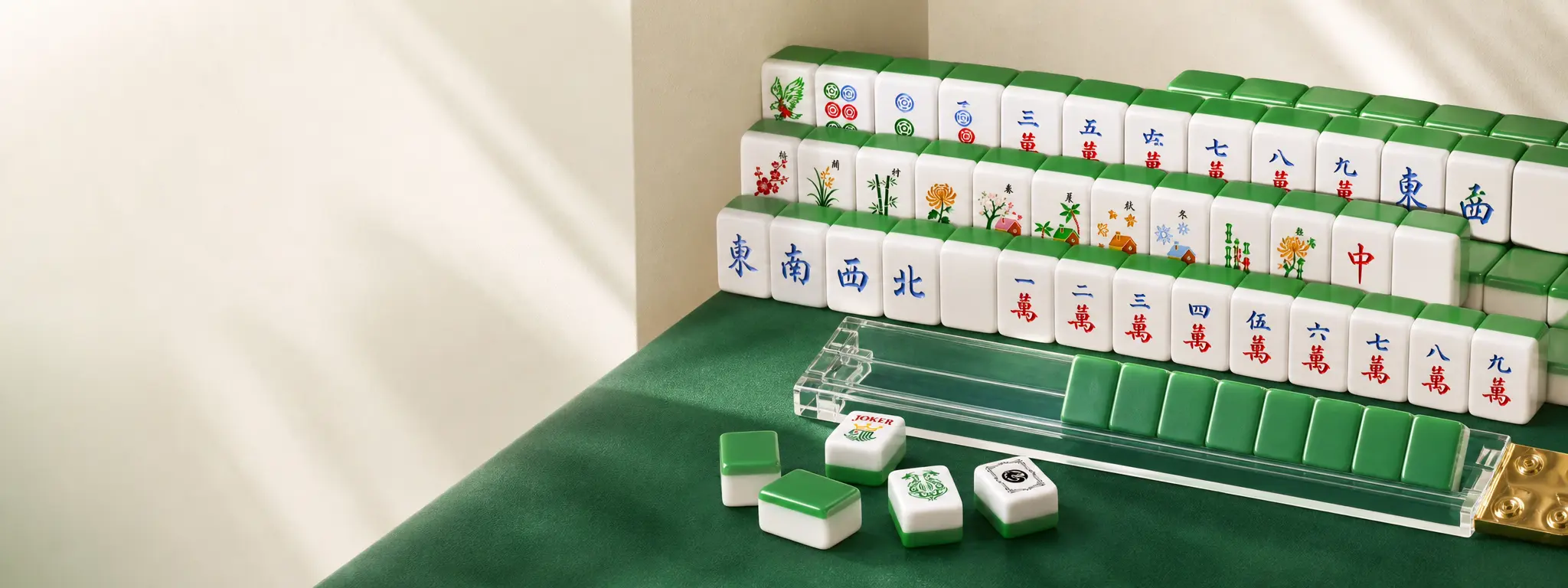

The most useful way to handle American Mahjong beginner mistakes is to name the moment they happen and change one action at the next turn. A new player does not need to stop making errors altogether. They need a quick way to tell whether the problem came from the equipment, the current card, the passing decision, or a rushed call.
This fix list covers twelve mistakes that show up around a real table. Each one has a symptom, a likely cause, and a small correction. Use it during a friendly game, then review only one or two items afterward. Trying to repair everything at once creates a thirteenth mistake: thinking about the checklist instead of the hand.
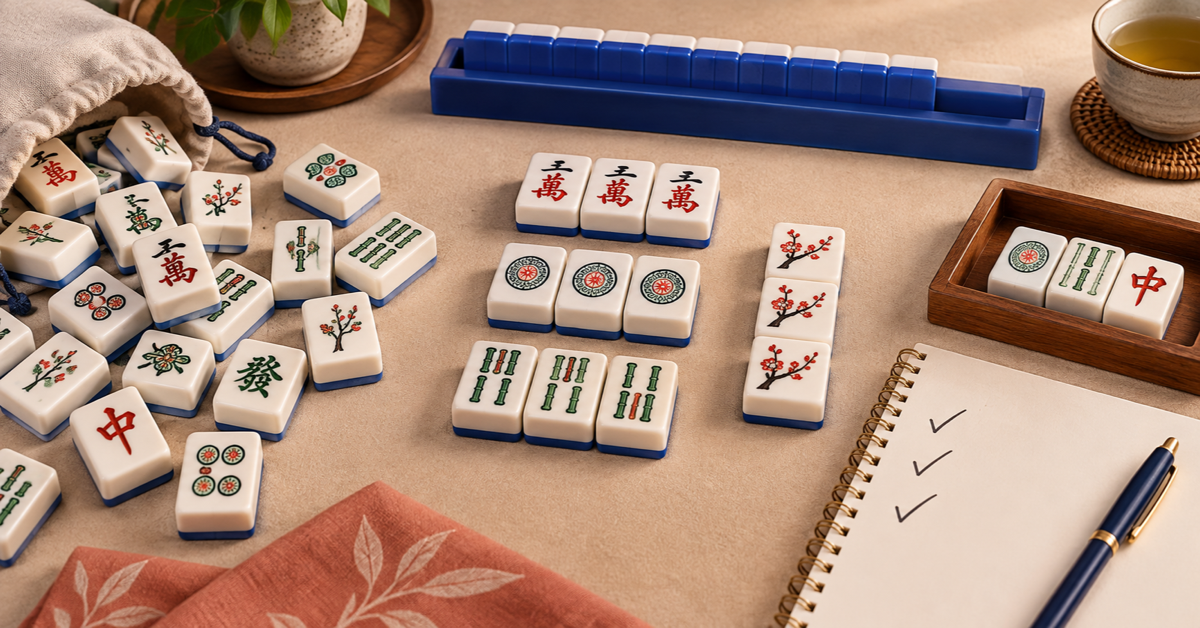
First, separate a mistake from a missing rule
Some table moments are not mistakes. A player can make a reasonable choice with incomplete information, or follow a house rule that differs from another group's routine. Before correcting someone, ask which rule card, edition, and table agreement is in use.
The real warning signs are repeatable: the same tile family is misnamed every game, a player loses the Charleston order, a rack fills with hopeful tiles, or an exposed hand no longer matches the line being pursued. Those patterns are useful because they can be observed and changed.
A quick diagnosis grid
| What you notice | Likely cause | Next-game fix |
|---|---|---|
| The player cannot find a suit quickly | Tile names are still being memorized as isolated pictures | Sort ten tiles by family before the next hand |
| A rack feels crowded and confusing | Every interesting tile was kept | Leave one clear discard decision space |
| The Charleston passes feel random | No plan was made before the first pass | Name the weakest group, then pass with a reason |
| A call happens before the hand is understood | The player is reacting to one attractive tile | Pause and check the full line on the card |
| A Joker is treated like an ordinary tile | The hand's substitution rule is unclear | Mark Joker notes on the current card |
| Discards are forgotten immediately | No visual or verbal review habit | Repeat the last two relevant discards quietly |
| The player misses a turn | Attention is split between card and table talk | Keep the current line visible and announce the next action |
| A hand is exposed and then abandoned | The commitment was made too early | Wait for a second confirming tile before exposing |
| The rules question becomes an argument | The group is using different references | Stop, locate the written rule, then decide |
| Practice feels busy but does not improve play | Sessions have no measurable target | Track one accuracy or timing result |
| The set slows down every setup | Equipment does not match the players or table | Check tile size, rack fit, and the table layout |
| The same error returns next week | The correction was never written down | Add one sentence to a game note |
This grid is not a scorecard. It is a way to find the smallest useful intervention.
Mistakes before the first deal
1. Buying a set that does not fit the game
An attractive box can still be the wrong starting point. The player may discover that the tile count, Joker configuration, rack channel, or rules reference does not match the American game their group plays. This is one of the most expensive American Mahjong beginner mistakes because it creates confusion before the first tile is drawn.
Use an American Mahjong beginner equipment check before ordering: confirm the intended version, readable faces, compatible racks, and the accessories that are actually included. A complete inventory matters more than the word “complete” in a product title.
2. Learning names without handling the tiles
Reading a list of Dots, Bams, Craks, winds, dragons, flowers, and Jokers is not the same as recognizing them in a moving hand. Beginners often know the vocabulary until the tiles are face down, mixed, or standing in a rack.
Use ten tiles at a time. Turn each face up, name the family, and place it in a matching group. Then mix only the tiles that caused hesitation. The American Mahjong tiles guide is a useful reference, but the hands-on sort is what makes recognition quicker.
3. Treating the annual card as background reading
The card is not a poster that sits beside the table. It is the current map of possible hands, notes, and restrictions. A beginner who memorizes tile names but never learns how to scan the card will spend every turn searching from the top.
Practice finding one feature at a time: a Dragon, a pair, a sequence, or a hand that allows a Joker. Mark the line on a separate note rather than writing on a card that belongs to someone else. The goal is faster searching, not total memorization.
4. Filling the rack with every tile that looks promising
Keeping every attractive tile feels cautious, but it removes the space needed to compare hands. A rack full of disconnected pairs can look busy while giving no clear direction.
At the beginning of a hand, group the tiles by suit and special family. Identify one or two possible lines, then label the tiles that support each line. Anything that supports neither line is a candidate for a future discard. The point is not to discard immediately; it is to make the decision visible.
Mistakes during the Charleston and early hand
5. Passing tiles without saying why
The Charleston can feel like a speed test. New players pass whatever is farthest from the rack or whatever they personally dislike. That loses the information in the opening hand.
Before each pass, use a short reason: isolated high tile, duplicate that does not serve a line, or a suit that is unlikely to stay. You do not need to announce private strategy. A quiet reason in your notebook is enough to make the next pass more deliberate.
The American Mahjong Charleston rules guide can help separate the route, blind pass, and courtesy exchange. Follow the current rules your table uses when deciding what may be passed.
6. Keeping a tile because it might become useful
“Maybe” is not a plan. A tile can be technically useful and still be the weakest choice among the tiles in front of you. Beginners often keep a single isolated tile while discarding the pair or connected group that gives the hand structure.
Try a two-column note: “supports a line now” and “hope only.” When the hand changes, move the tile between columns. This turns an emotional keep into a visible decision and makes review possible later.
7. Losing the pass direction
A player can understand the Charleston and still pass to the wrong seat when conversation gets loud. The physical packet moves quickly, and the error may not be noticed until the next exchange.
Point to the receiving seat before moving the tiles. Use the same phrase every time, such as “to my left,” and confirm the courtesy pass separately. A small directional habit is more reliable than trying to reconstruct the route from memory.
8. Calling a tile before checking the whole line
An exposed group can feel like progress, especially when the tile completes a pair or pung. But the call changes what the hand can become. One attractive tile is not enough evidence if the rest of the line remains unlikely.
Before calling, ask three questions: Which exact line am I pursuing? What tiles remain missing? What will I discard if the next draw is neutral? If you cannot answer one of them, keep the hand concealed for another turn when the rules allow it.
9. Using a Joker without checking its role
Jokers are flexible in some situations and restricted in others. A beginner may use one to complete a group that does not permit it, or protect a Joker while overlooking a better line that needs it elsewhere.
Keep the Joker note beside the current card line. Ask the table to clarify a rule before exposing the group, not after. The American Mahjong rule card guide gives a reading method; the current rules and table agreement control the play.
Mistakes in the middle of a hand
10. Forgetting what has already been discarded
Memory is unreliable when the table is talking. A beginner may wait for a tile that has already appeared twice or discard a tile that was clearly being watched by another player.
Do not try to memorize every discard. Track only information that changes your current decision: a tile you need, a duplicate that reduces its value, or a visible exposure that narrows a line. Say the two most relevant discards quietly as a hand review, then return attention to the rack.
11. Changing hands every time a new tile arrives
Flexibility is useful, but constant switching creates a hand with no destination. A new tile can be interesting without being better than the line already supported by the rack.
Use a “two-draw rule” for practice: after a neutral draw, keep the current plan and reassess; after a draw that changes the shape, compare the old line with one new line. This is not a universal playing rule. It is a training guardrail that stops every draw from becoming a full reset.
12. Staying silent when the rules are unclear
Beginners sometimes hide a question because they do not want to slow the table. That turns a small uncertainty into a repeated mistake, especially around calls, Jokers, exchanges, or the meaning of a card symbol.
Ask a precise question: “Does this line allow a Joker in the pair?” is easier to answer than “Can I use this?” If the table cannot agree, pause and check the written reference. A calm question protects the game better than a confident guess.
Correct one mistake with one short drill
The best correction is small enough to repeat before the next game. Choose the drill that matches the error:
| Repeating problem | Five-minute correction |
|---|---|
| Slow tile recognition | Sort 20 mixed tiles by family and name each one aloud |
| Random Charleston passes | Deal a practice hand and write one reason beside each pass |
| Card scanning takes too long | Find three lines containing one chosen tile, then stop |
| Calls happen too early | Build a concealed candidate and list its missing pieces |
| Discards disappear from memory | Record only the two discards that affect your line |
| The same rules question returns | Write the answer with the page or card section where it came from |
Solo work can support these drills. The four-week American Mahjong practice plan is useful when a player wants a routine rather than a one-off correction. Keep the goal narrow enough that you can tell whether the drill helped.
Keep a correction note after the game
Do not write a full review of every turn. Use three lines:
- The moment I hesitated
- The choice I made
- The next signal I will watch for
For example: “I kept a lone high tile through two passes; next time I will mark isolated tiles before the first exchange.” That note describes a behavior instead of labeling the player as bad at Mahjong.
The next session should test the note once. If the same situation appears and the player makes a different choice, the correction is working even if the hand does not win. Improvement is a better measure than a single result.
FAQ
What are the most common American Mahjong beginner mistakes?
The most common are choosing the wrong equipment or version, struggling to recognize tile families, scanning the card too slowly, passing without a reason, calling before understanding the line, and forgetting what has already been discarded. Each one improves faster when it is named at the moment it occurs.
How can I avoid mistakes when I first start playing American Mahjong?
Use a current rule reference, learn the tiles in small groups, keep the rack organized by family, and choose one correction goal for each session. A short note after the game is more useful than trying to memorize every table conversation.
What American Mahjong beginner equipment do I actually need?
Start with a compatible tile set, four stable racks, the accessories your group uses for the wall, dice, and the current rules or card reference. Confirm the tile size and included pieces before buying; a large bundle is not automatically the right bundle.
How do I learn American Mahjong at home without creating bad habits?
Practice recognition, card scanning, and passing decisions with a written target. Say which rule or line you are testing, keep the current reference visible, and review one decision afterward. Home practice should build habits that transfer to a four-player table.
Should a beginner call a tile whenever it helps?
Not automatically. A call changes the shape and information of the hand. Check the exact line, missing tiles, Joker rule, and likely next discard before exposing a group. When the plan is unclear, asking a rules question is safer than rushing.
How do I know whether a mistake is improving?
Track an observable behavior: fewer tile-name pauses, a clear reason for each pass, faster card searches, or a written answer to a repeated rules question. A hand result can be lucky; a repeatable decision is evidence of learning.
Beginner play becomes calmer when an error is treated as a signal instead of a verdict. Name the pattern, change one action, and bring the note back to the next table.