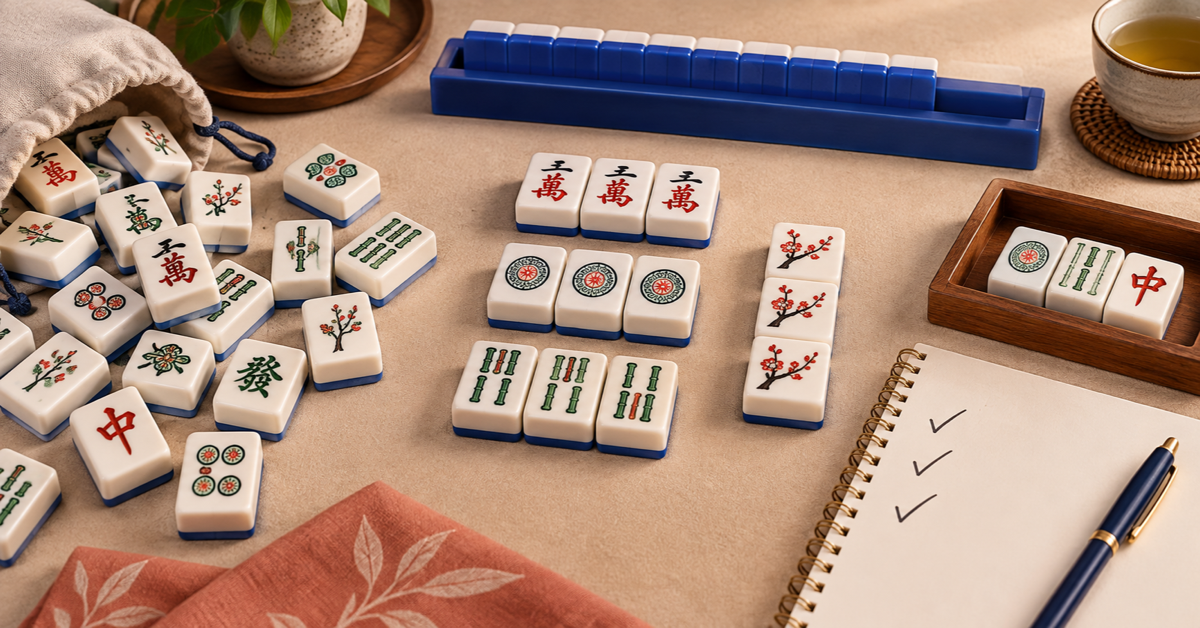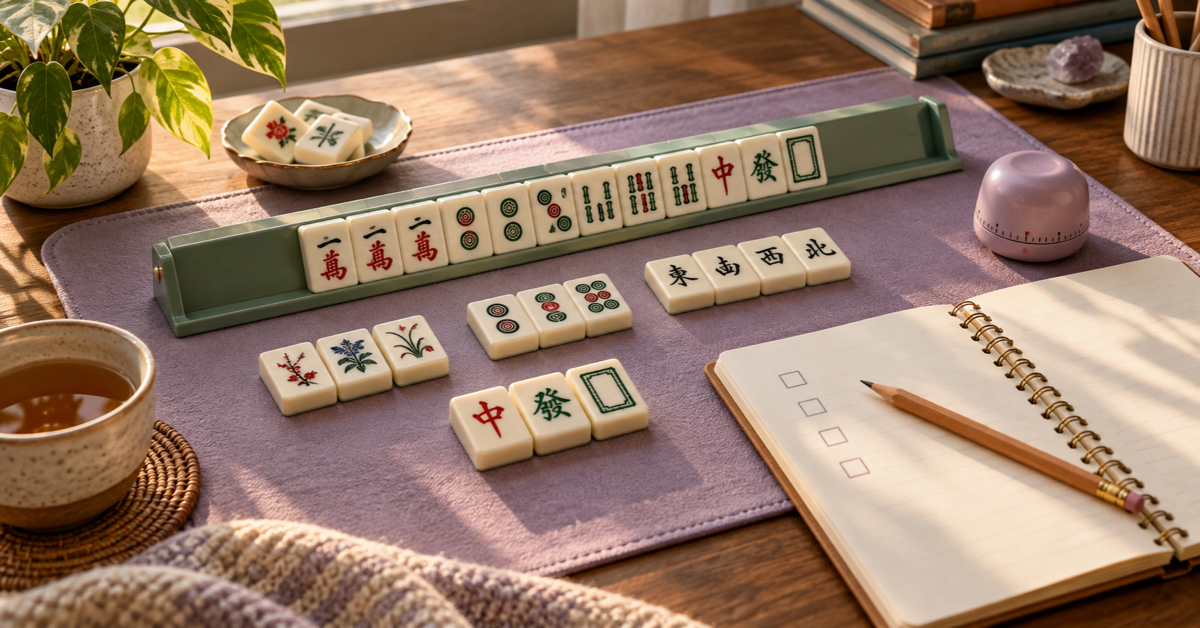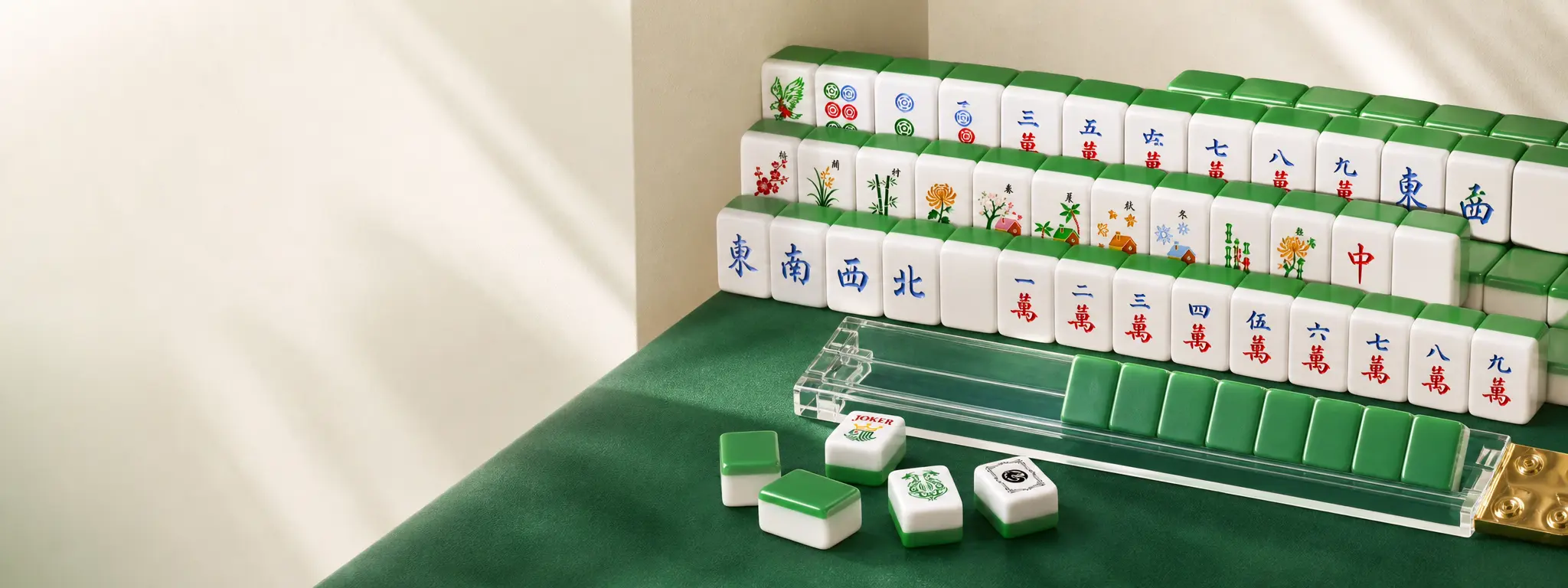

The fastest way to learn how to choose a hand in American Mahjong is to stop searching the card for one perfect match. Begin with the shapes already on your rack, find two or three card lines they could support, and compare those candidates before the Charleston or the next discard changes the hand.
That choice is provisional. A useful first direction should organize your passes and discards without locking you into a line too early. The current official card controls the actual hands, notes, values, and exposure rules, so keep it open and check the exact line rather than relying on last year's memory.
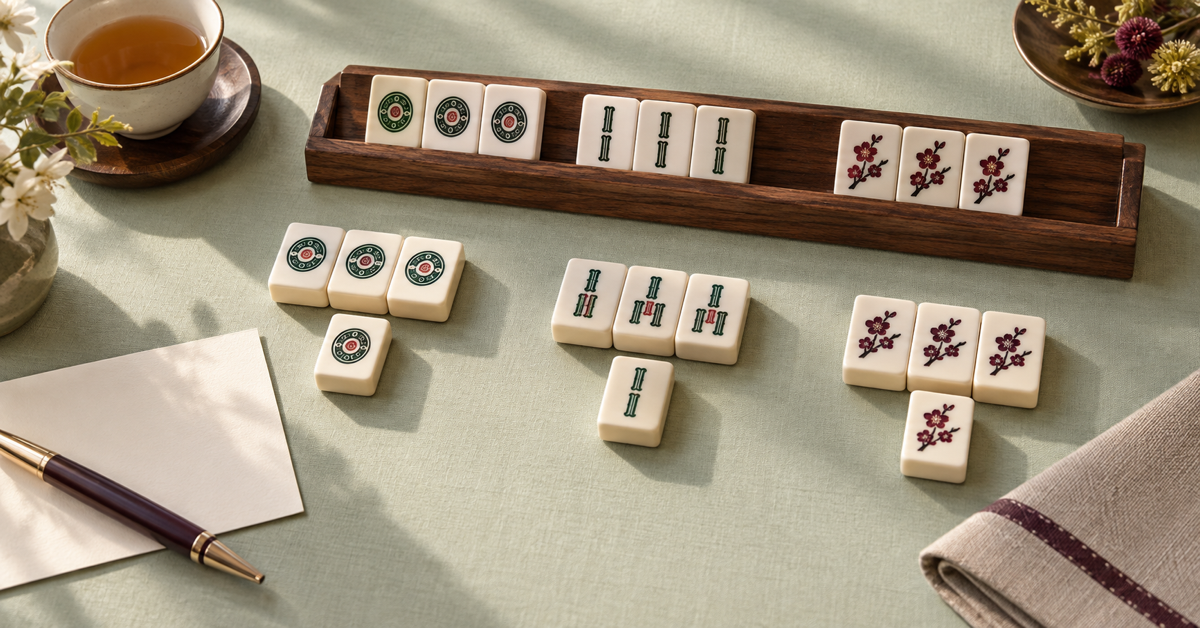
Start with evidence on the rack
New players often open the card at the top and read every line while their tiles sit untouched. That makes the task feel much larger than it is. Reverse the order: read the rack first, then use the card to test what the rack suggests.
Look for evidence that is already real:
- A pair or repeated number
- Two or three connected numbers in one suit
- The same number in more than one suit
- Flowers, winds, Dragons, or Jokers that may support a listed pattern
- A suit with several tiles and another suit with only one isolated tile
Do not call any of these groups a hand yet. They are anchors, not commitments. A pair may point toward several lines, and a run of numbers may fit more than one section. The goal is to reduce the search area on the card.
If tile names still slow the scan, review the American Mahjong tiles guide before practicing this decision. Fast recognition gives you more time for the comparison that matters.
How to choose a hand in American Mahjong step by step
Use the following sequence at the start of a practice hand. With repetition, the steps become a short table routine rather than a long analysis.
1. Make a loose family sort
Place suits together and keep special tiles easy to see. Avoid building one rigid left-to-right arrangement that you must rebuild after every draw. Leave small gaps between promising groups so you can see which tiles work together.
A loose sort answers three questions quickly:
- Which family has the most support?
- Where are the pairs or repeated values?
- Which tiles are isolated?
An isolated tile is not automatically a discard. It may be essential to a card line. It is simply a tile that needs stronger evidence before you protect it.
2. Circle the anchors, mentally or on a practice note
An anchor is a feature that would be inconvenient to rebuild from scratch. A natural pair is an obvious example, but two related groups can also be meaningful. Write down no more than three anchors. If everything is marked as important, the note does not help.
Try descriptions such as:
- Pair plus three nearby numbers
- Same number in two suits
- Flower group with one strong suit
These descriptions are intentionally generic. They keep your attention on the rack without copying or guessing a protected line from the annual card.
3. Scan the current card in three passes
The first pass is broad. Look only at section names and visual shapes that could use one of your anchors. Skip sections that clearly need a structure your rack does not have.
The second pass is exact. Read the full candidate line, including suit relationships, grouping, color, and any notes. The American Mahjong rule card guide explains a repeatable way to read those parts without treating the card as a wall of symbols.
The third pass checks restrictions. Confirm whether the line is concealed or exposed, where Jokers may or may not be used, and whether a pair must remain natural. Card content changes from year to year. A remembered line is not evidence until it matches the card in front of you.
Stop after you find three plausible candidates. Continuing to collect options usually creates noise rather than a better decision.
4. Count support, not just matching tiles
A tile supports a candidate when it already occupies a required place or belongs to a flexible group that can move into that line. Count what you own, then separate the missing pieces into common-looking needs and narrow needs.
Use a small comparison like this during practice:
| Candidate | Useful tiles now | Strong anchor | Difficult gap | Exposure condition | Backup value |
|---|---|---|---|---|---|
| A | 7 | Natural pair | Two specific singles | Check current card | Shares a suit with B |
| B | 6 | Connected group | One pair | Check current card | Many tiles also help A |
| C | 8 | Repeated number | Several exact values | Check current card | Little overlap with A or B |
The numbers are not an official scoring system. They are a way to expose a common trap: Candidate C can have the highest raw count while still being fragile because its missing tiles are too specific and its pieces have little backup value.
5. Prefer the candidate with a useful backup
Early in the hand, flexibility is part of strength. Compare your best two lines and ask which tiles survive if the table stops feeding the expected pattern.
Candidate A is usually safer when several of its tiles also support Candidate B. Candidate C may be attractive when it has a rare pair or a very strong starting shape, but it deserves a closer restriction check before you pass away every alternative.
This does not mean choosing the vaguest hand. It means keeping one planned exit. The beginner strategy guide covers the broader balance between direction and flexibility.
6. Use the Charleston as a checkpoint
The Charleston is not only a way to remove unwanted tiles. It is the first test of whether your candidate has a coherent core. Before each pass, label three groups:
- Tiles that support both leading candidates
- Tiles that support only one candidate
- Tiles that support neither candidate
Pass from the third group first when the current rules and table situation allow. Protect the shared tiles while the decision is still close. After receiving new tiles, repeat the candidate comparison rather than forcing the original plan.
For passing order, blind-pass details, and table procedure, use the American Mahjong Charleston rules guide and the current rules followed by your group.
7. Name a primary line and one backup
By the end of the Charleston, write or quietly state one primary candidate and one backup. Include the exact card location so you can return to it without another full scan.
A useful note looks like this:
Primary: section and line, supported by the pair and six working tiles. Backup: section and line, sharing four of those tiles. Recheck after an exposure or two unhelpful draws.
The note is not a promise to stay. It simply gives the next draw a context.
Know when to stay and when to pivot
Players often switch too frequently because every new tile looks like a fresh possibility. Others stay too long because they invested several passes in the first idea. Use visible signals instead of mood.
Signals to stay
- A draw completes or strengthens an anchor
- Several missing tiles remain live enough to be reasonable targets
- The primary and backup still share useful material
- Your planned discards are clear
- A legal exposure confirms the exact line
Signals to compare again
- Two draws add nothing while the backup gains support
- Needed tiles appear repeatedly in discards or exposures
- A key pair is no longer realistic to build
- The exact line has a restriction you missed
- Calling a tile would leave no sensible next discard
The number of draws is not a formal rule. During practice, a two-draw checkpoint is useful because it prevents a complete card search after every neutral tile. At the checkpoint, compare only the primary and backup unless the rack has changed dramatically.
Delay exposure until the line survives a full check
Calling a tile can make an uncertain plan feel official. Before exposing, point to the exact line and verify the group, suit relationship, and current-card restrictions. Then name the tiles still missing.
If you cannot complete that sentence, the hand may not be ready for an exposure. This is especially important when a Joker is involved or when one candidate is concealed. A premature call can remove your backup and reveal information without solving the actual hand.
Use this three-part pause:
- Exact line
- Legal group
- Next discard
If all three are clear, the call is at least consistent with the plan. It can still be a strategic mistake, but it is no longer an accidental one.
A four-checkpoint table routine
The complete method can be reduced to four moments:
| Moment | Question | Output |
|---|---|---|
| Opening rack | What are my three strongest anchors? | A loose sort and three notes |
| First card scan | Which three lines use those anchors? | Three candidates |
| End of Charleston | Which line has the best support and backup? | Primary plus backup |
| Before a call or pivot | Does the exact card line still work? | Stay, expose, or compare again |
Keep the routine short enough that play continues. If the table is waiting while you build a spreadsheet in your head, return to the strongest anchor and two candidates.
Common hand-selection mistakes
Choosing by point value first
A higher-value line is not automatically the better starting direction. Point value matters only after the hand can realistically be completed. Compare support and restrictions before treating value as a tiebreaker.
Protecting every pair
Pairs look valuable, but a rack full of unrelated pairs can block a clearer line. Keep the pair that supports a real candidate and question the pair that survives only because it feels difficult to discard.
Counting Jokers as support everywhere
A Joker does not erase the need to read the line. Check where it can legally be used under the current card and rules. Do not let one flexible tile make three weak candidates look equally strong.
Searching the whole card after every draw
A neutral draw rarely requires a complete restart. Compare the current plan with the backup first. Open the search only when the rack gains a new anchor or loses the feature that made both candidates work.
Hiding the line from yourself
Keeping the plan only in memory makes it easy to drift. During solo practice, record the exact card location and the reason for choosing it. At a live table, place the current card so the line can be checked without rearranging the rack.
These mistakes also appear in the broader American Mahjong beginner mistakes checklist. Hand selection improves fastest when one repeated error is corrected at a time.
Practice the decision without playing a full game
Deal a concealed practice rack and set a three-minute timer. Make the loose sort, identify anchors, and find three candidates. Write the comparison table with only short phrases. Then simulate one Charleston pass and draw three random replacement tiles.
At the end, answer four questions:
- What evidence produced the first candidate?
- Which missing piece made one candidate fragile?
- How many tiles were shared with the backup?
- What event would make you pivot?
Run the same rack twice. On the second run, try to reach the candidates faster without skipping the restriction check. Speed is useful only when the result is still traceable to the card.
For a longer routine, add this exercise to the four-week solo American Mahjong practice plan. A stable rack, readable tiles, and a card holder also make the comparison easier to repeat; browse JOKKOL's American Mahjong sets when you need equipment for a home practice table.
FAQ
How do you choose a hand in American Mahjong from the opening tiles?
To practice how to choose a hand in American Mahjong, sort the rack loosely, identify up to three anchors, and scan the current card for three lines that use them. Compare useful tiles, difficult gaps, restrictions, and backup value. After the Charleston, reduce the list to one primary line and one backup.
Should I pick a hand before the Charleston?
Pick candidates, not a permanent hand. The opening rack should guide the first passes, but received tiles may strengthen a different line. Protect tiles shared by two candidates until one direction has clearer support.
How many possible hands should I keep open?
Three candidates are enough for the first scan. By the end of the Charleston, narrow them to a primary line and one backup. Keeping more options often makes passing and discarding less consistent.
Is the hand with the most matching tiles always best?
No. A raw count can hide difficult gaps, a concealed restriction, or tiles that have no backup use. Compare the quality of the missing pieces and the flexibility of the supporting tiles, not only the total.
When should I change my chosen hand?
Recompare when your backup gains a strong anchor, required tiles become visibly scarce, a restriction invalidates the plan, or an exposure would leave no clear path. A neutral draw alone does not always justify a full restart.
Can I memorize hands instead of scanning the card?
Memory helps with speed, but the official card changes annually and exact notes matter. Use memory to find a section, then verify the complete line and restrictions on the current card before passing, calling, or declaring.
Learning how to choose a hand in American Mahjong is less about guessing the winner early and more about making the next decision coherent. Read the rack, test a small set of card lines, protect a useful backup, and let new evidence change the plan when it truly matters.