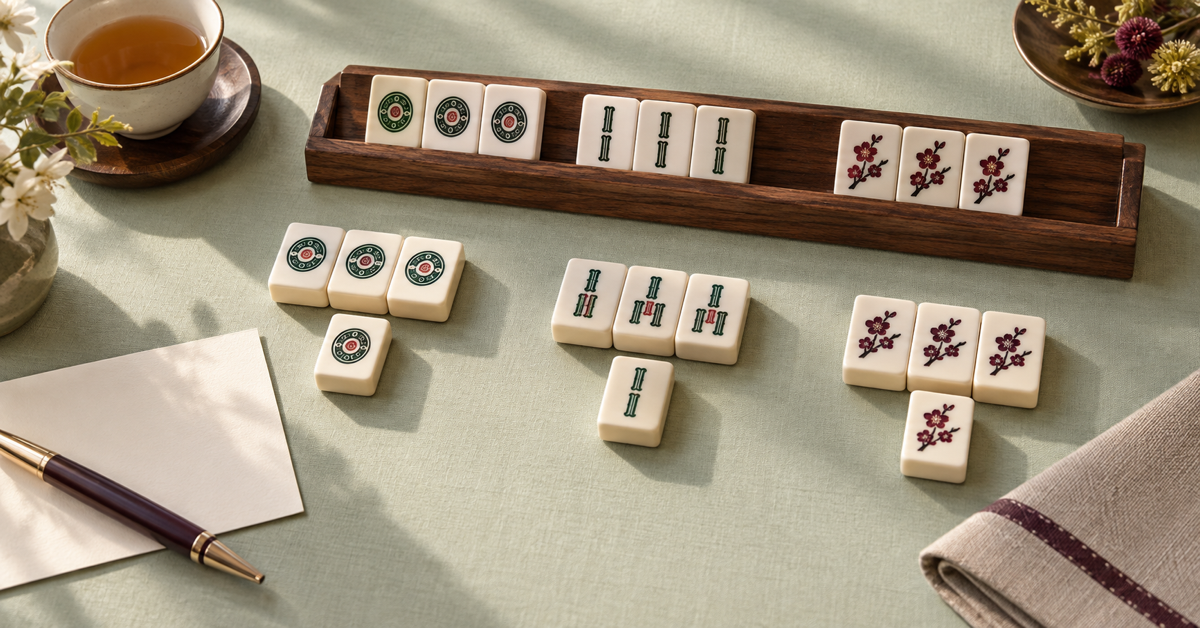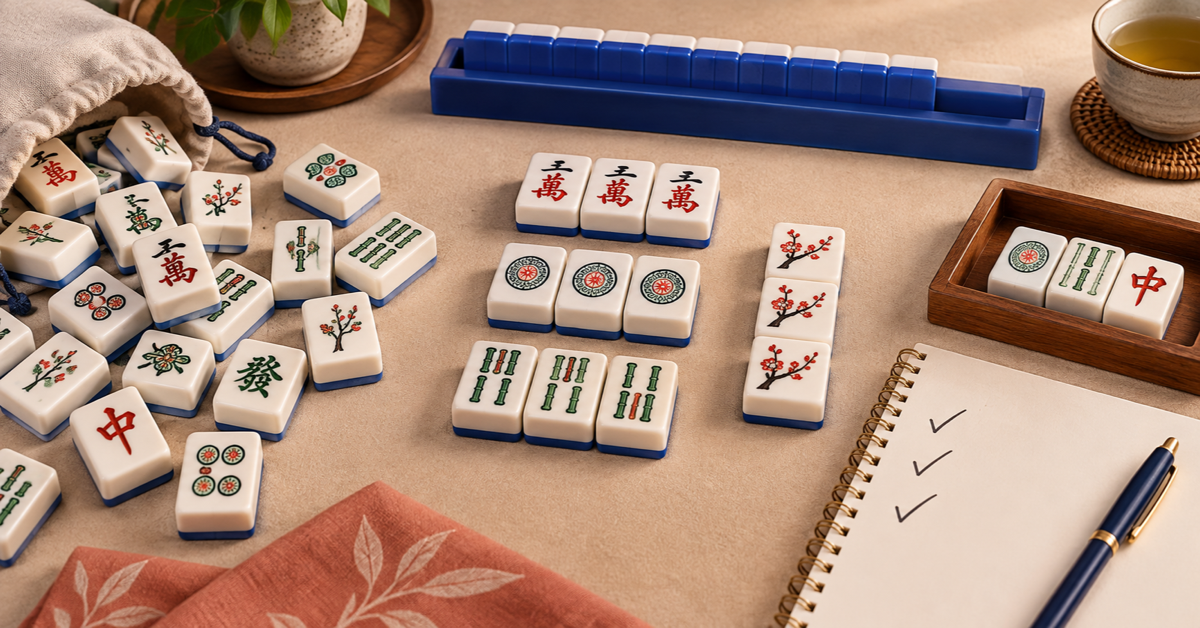

Learning how to practice American Mahjong alone is possible, but solo practice is not a complete game. American Mahjong is built around four players, changing hands, calls, and table decisions. Alone, you can still train the skills that slow a learner down: identifying tiles, reading the current card, passing in the Charleston, arranging a hand, and reviewing a decision without rushing.
The plan below uses short sessions and a simple progress notebook. It is designed for one player with a table, a correct tile inventory, a rack, and the rules or hand card used by their group.
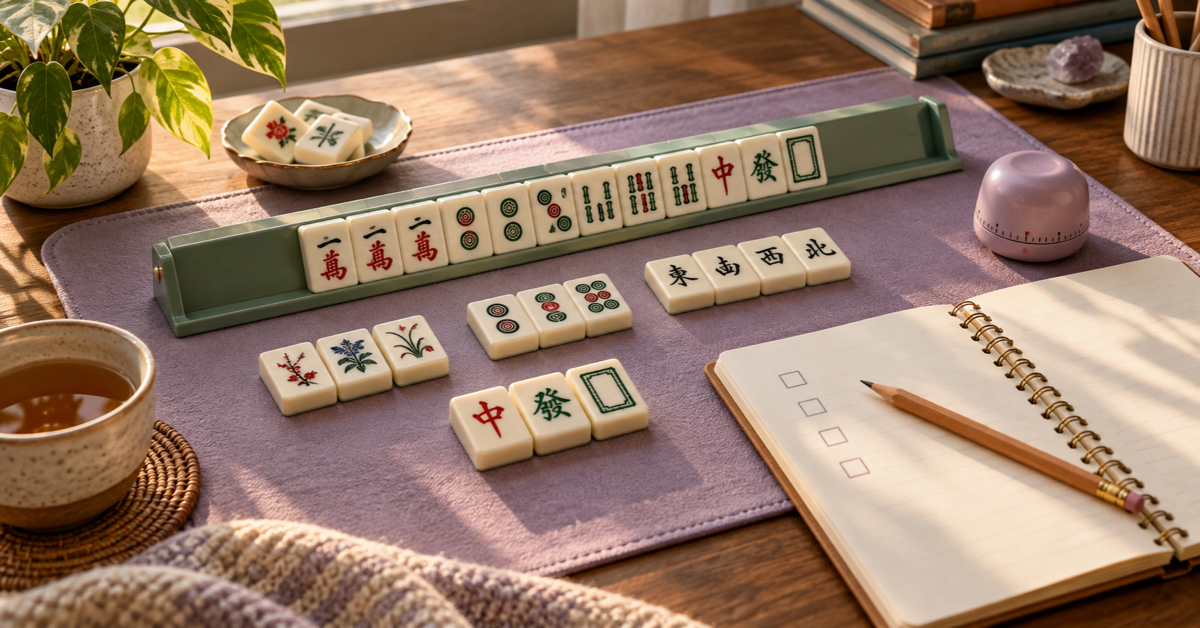
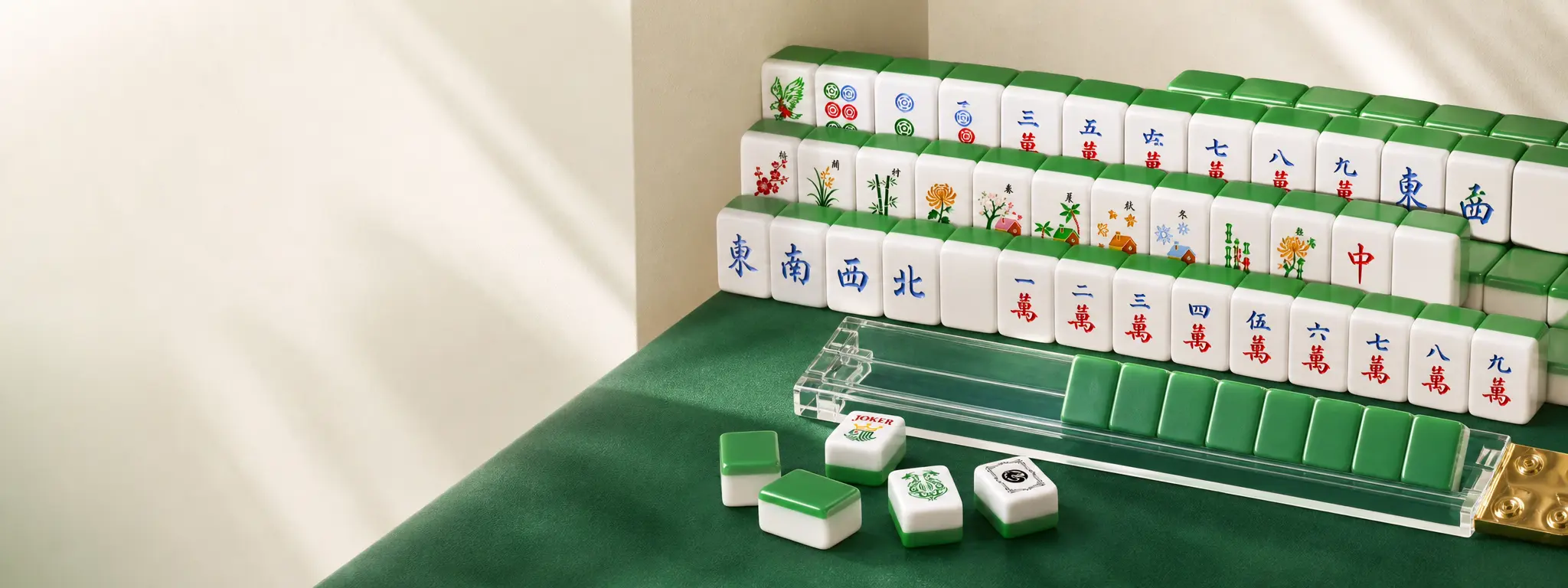
Display image: solo drills train recognition, handling, and review skills; they do not simulate every four-player decision.
Set up a practice corner
Use the same rack and table you will use for real games. Put the tiles face down in a mixed arrangement, place the rule reference where it can be read without holding it, and keep a notebook nearby.
An effective practice session has four parts:
| Part | Time | Purpose |
|---|---|---|
| Warm-up | 3 minutes | Recognize ordinary tile families |
| Main drill | 12-15 minutes | Train one specific skill |
| Review | 5 minutes | Record errors and decisions |
| Reset | 2 minutes | Return every piece to its place |
Twenty-five minutes is enough. A focused drill is more useful than a long session spent shuffling without a goal.
The question is not whether you can practice American Mahjong alone. It is which skill deserves attention today and how you will recognize progress.
Before week one: create a progress page
Write these headings at the top of a notebook page:
- Drill and date
- Time or accuracy result
- The tile or rule that caused hesitation
- One correction for next time
- One question to ask an experienced player
Do not grade yourself on whether the drill "felt good." Record something observable: tiles named correctly, lines found in three minutes, passes completed without an ordering error, or decisions you can explain.
Week 1: build automatic tile recognition
Drill 1: face-family sort
Place 40 tiles face up in a loose group. Sort them into Dots, Bams, Craks, winds, dragons, flowers, and Jokers. Repeat with a smaller batch but place each tile on its matching family pile within two seconds.
The aim is not speed alone. Say the family aloud as you place the tile. If a white dragon looks blank, say "soap" or the term your group uses. If a One Bam has unusual artwork, use the same name the group's rules and card use.
Drill 2: face-down layout
Turn ten tiles face down and arrange them in a row. Randomly choose one, turn it face up, and name it before returning it. This separates recognition from the habit of following the visual order in a pile.
Drill 3: difficult-face lineup
Choose the five faces that gave you the most trouble. Put them in a row and write a short clue for each one beside the tile. Remove the clues and repeat. End the session by naming all five once with the clues visible again.
For a fuller vocabulary of tile families, keep the American Mahjong tiles guide nearby.
Week 2: learn to scan the current card
Card reading is a separate skill from tile recognition. Train the eye to move through the lines without trying to memorize every hand.
Drill 4: three-line scan
Open the group's hand card. Give yourself three minutes to find all lines that use a chosen tile, such as a specific Dragon or a particular pair. Mark them lightly on a separate worksheet or note the line names in your notebook.
Repeat with a different tile. The purpose is to train search, not to decide whether a hand is good.
Drill 5: build the candidate
Choose one card line. Gather the tiles needed from your set, leaving spaces where a Joker or another tile would be required. Say the line aloud in sections: what it needs, what is flexible, and what cannot be replaced.
Our rule card guide explains how to separate sections and use Joker notes. Practice with the current reference your group uses.
Drill 6: compare two candidates
Choose two lines that share at least one tile. Lay the required pieces for each on opposite sides of the rack. Write one sentence explaining which line is easier to pursue with the tiles you can actually see rather than with the tiles you hope to receive.
This drill does not predict the best move in a real hand. It builds the habit of comparing options instead of stopping at the first interesting line.
Week 3: rehearse the Charleston route
Solo Charleston practice cannot reproduce four-player decisions, but it can make the sequence and physical handling automatic.
Drill 7: direction grid
Place four chair markers or pieces of paper around the table. Stand at each position and point right, left, and across before moving a packet. Say the direction from that seat rather than from the host's viewpoint.
Then rehearse the first sequence with three non-Joker tiles: right, across, left. If your group uses the optional second sequence, practice left, across, right on a separate round.
Drill 8: three-tile packet check
Make a packet of exactly three tiles. Turn it face down, move it around the table, and exchange it with another packet you have prepared. Count the outgoing and incoming pieces after each move. The goal is to keep the packet intact without looking at the faces.
Review the Charleston practice session for the sequence, blind-pass arithmetic, and courtesy exchange. Use your group's current rules for any variation.
Drill 9: pass with a reason
Deal a practice hand to each of four racks, even though you are the only player. Choose one rack and write a sentence explaining three tiles you might pass: which candidate line they fail to support, and what type of incoming tile would make you reconsider.
Do not evaluate the result as if the other three hands had acted normally. This is a reasoning exercise.
Week 4: connect skills under a clock
Drill 10: two-minute table setup
Place four racks, arrange the dice, put the rule reference in view, and organize the tile inventory. Repeat until the setup is predictable. Do not sacrifice accuracy for speed.
Drill 11: hand reading and exchange
Choose one line, build it with visible tiles, then make a three-tile packet as if the Charleston were beginning. After the physical exchange, return to the line and name one tile that would strengthen it and one tile that would make you consider a different line.
Drill 12: review without replaying the whole game
At the end of the week, review the notebook. Mark the three errors that appeared more than once, such as confusing two faces, losing track of a direction, or overlooking a Joker restriction.
Create one final five-minute drill for each recurring error. The purpose of the review is to choose the next practice target, not to prove that you have mastered every situation.
Sample four-week schedule
| Week | Main target | End-of-week check |
|---|---|---|
| 1 | Tile recognition | Name a mixed group accurately without prompts |
| 2 | Card scanning | Find relevant lines and explain two candidate directions |
| 3 | Charleston handling | Complete the route and keep every packet at three tiles |
| 4 | Combined setup and review | Move from setup to card reading to practice pass without losing count |
Keep sessions short enough to repeat. Three 20-minute practices in a week usually teach more than one long session followed by a week of no play.
What solo practice can and cannot do
Solo practice can improve recognition, rules familiarity, handling, card search, and self-review. It can help a player arrive at a real table with more confidence and fewer basic questions.
It cannot reproduce the hidden information, timing, social cues, and changing priorities of a four-player game. It also cannot teach a player how to respond to every call or table disagreement. For those skills, play with people and review the rules your group follows.
If no regular game is available, ask an experienced player to review one notebook page or one practice setup. A short conversation can correct an error before it becomes a habit.
Frequently asked questions
Can you practice American Mahjong alone?
Yes. A practical approach to how to practice American Mahjong alone is to train tile recognition, card reading, Charleston routing, hand organization, and decision review. A solo drill does not replace playing with four people.
Is Mahjong solitaire the same as American Mahjong practice?
No. Mahjong solitaire is a matching game. It is not the four-player American Mahjong game or its hand-building rules.
How long should a solo practice session last?
Twenty to thirty minutes is enough when the session has one clear target. End with a short review and record the next skill to practice.
What should a beginner practice first?
Start with tile recognition and the current rule card. Add Charleston handling after the faces feel familiar, then combine the skills in short sessions.
How do I know whether solo practice is helping?
Track observable results such as faster recognition, fewer direction errors, or clearer reasons for a practice pass. If the same mistake repeats, turn it into a smaller drill.
The best way to practice American Mahjong alone is to choose one skill, make the drill measurable, and review it honestly. A clear tile inventory, a comfortable rack, and the correct rule reference give that practice a useful table context. Browse JOKKOL Mahjong sets or contact JOKKOL with model-specific questions.
Use this four-week plan as a repeatable answer to how to practice American Mahjong alone, then replace each completed drill with a harder variation.