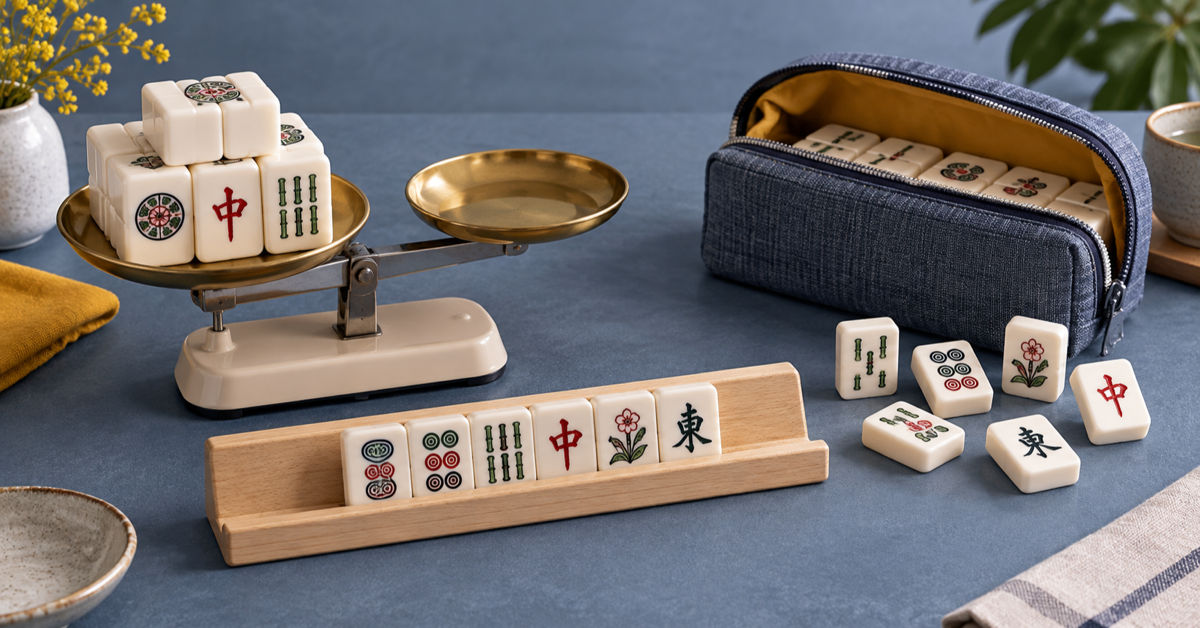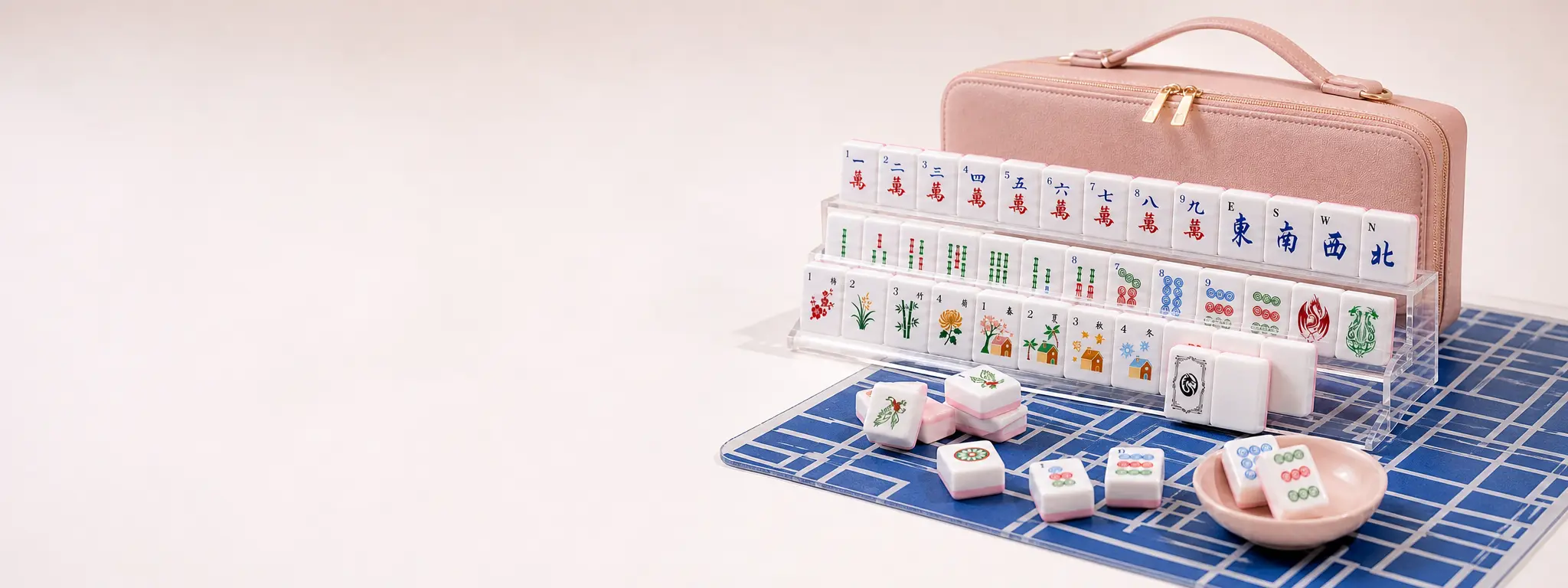

Mahjong tile size is a three-dimensional measurement: face height, face width, and thickness. You need all three to judge rack fit, case fit, and handling. A photograph beside a hand is not a measurement, and "standard" or "large" does not tell you whether a particular tile will sit properly in your rack. Ask for dimensions with units, then compare them with the equipment you already own.
This guide is a small measuring exercise. A ruler, your current rack, a few tiles, and a sheet of paper are enough to start. You are not trying to find the largest tile available. You are trying to find a size that works at your table without making the rest of the setup awkward.
Set up a useful measurement record
Put one tile face up, with its symbol upright. Measure the height from bottom to top and the width from left to right. Turn it on its side to measure the thickness from face to back. Write those names alongside the numbers. A sequence such as "30 x 22 x 12" is ambiguous without orientation and units.
Measure several tiles, not just the easiest one to reach. A worn piece, a chipped corner, or a ruler held at an angle can mislead you. If you use calipers, close them gently against the surfaces; pressing harder will not produce a more useful shopping specification.
| Measurement | What it helps you check | How to label your note |
|---|---|---|
| Face height | Visible area above the rack's front lip; case compartment height | Height, upright orientation, in millimeters |
| Face width | Space occupied by a row of tiles | Width, left to right, in millimeters |
| Thickness | Rack channel fit, stacking, and packed depth | Face-to-back thickness in millimeters |
| Actual row length | Whether your normal hand fits on the usable ledge | Number of tiles measured and total length |
| Case clearance | Whether the packed set closes without pressure | Internal space, not the outside case size |
For conversions, one inch equals 25.4 millimeters. Keep the original measurement as well as the conversion. Avoid rounding several values and then adding them: small rounding differences can accumulate across a long row.
Mahjong tile size and rack fit are not the same thing
A rack can be long enough but still hold the tiles badly. Its front lip may hide part of a number, its channel may be too narrow, or its support angle may make tall pieces unstable. These issues are difficult to judge from the rack's outside length.
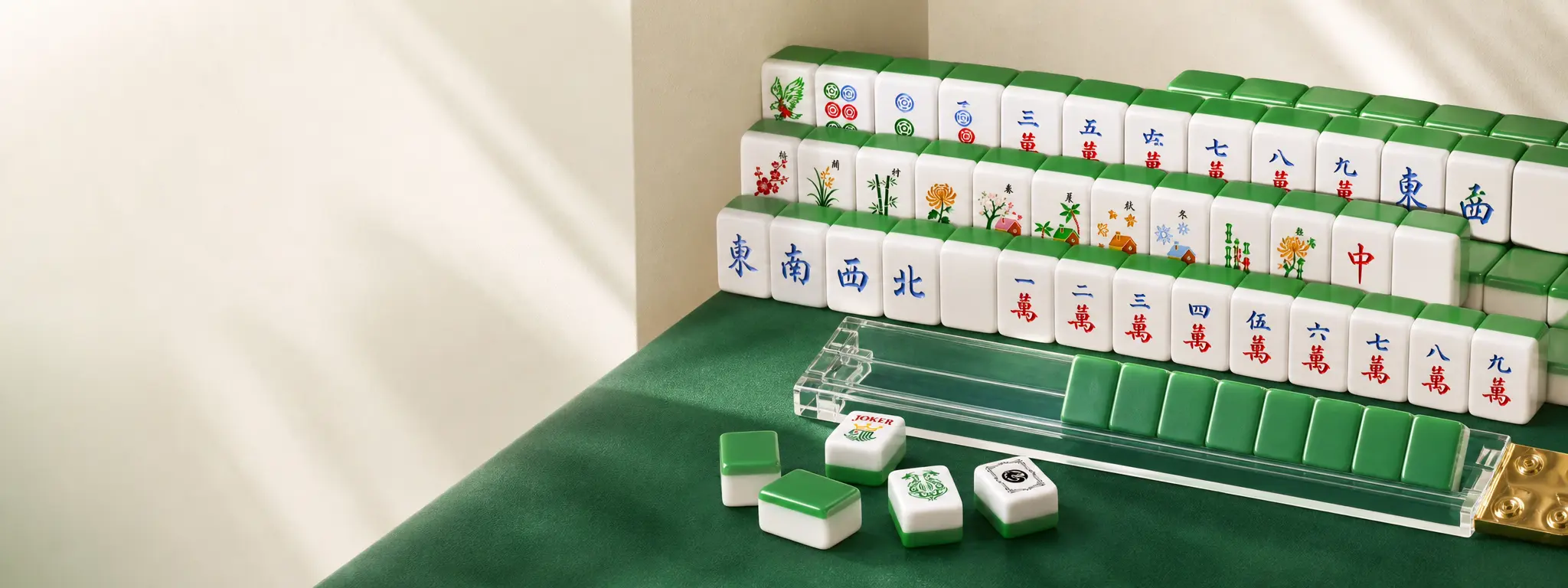
Display image only; use confirmed dimensions rather than measuring this photograph.
Place the tiles in the rack as you would during a game. Sit in your usual chair. Check whether you can distinguish the lower part of the symbols without lifting each tile. Then gently move the row and watch whether the tiles stay supported. This is a fit check, not a stress test.
If you do not own the proposed tiles yet, send the seller a photograph of your rack beside a ruler. Ask for the rack's usable ledge or channel measurement where relevant. "It fits most sets" is less helpful than a clear dimension and an explanation of how the tile rests.
The JOKKOL rack and pusher collection is a place to compare options. Check the current specifications with the team before assuming that any rack and any tile model are interchangeable.
Try the row-length calculation
Suppose a hypothetical tile is 22 millimeters wide. Fourteen touching tiles occupy 308 millimeters before allowing for gaps or end clearance. That is a worked example, not a JOKKOL specification or a recommended minimum rack length.
Now consider how you actually arrange your tiles. Do you leave a little space between groups? Does an end fitting take up part of the ledge? Those details explain why a bare multiplication is only a starting point. Measure a real arrangement whenever possible and leave room to move pieces comfortably.
Do not use the advertised rack length as the usable length without checking. Hinges, end pieces, or attached accessories may occupy space that a product photograph makes easy to overlook.
Check readability from the chair, not the shopping photo
Bigger tiles do not automatically have bigger symbols. A generous border, decorative artwork, or a small number printed in a corner can leave the useful information quite modest. Compare the faces themselves as well as overall mahjong tile size.
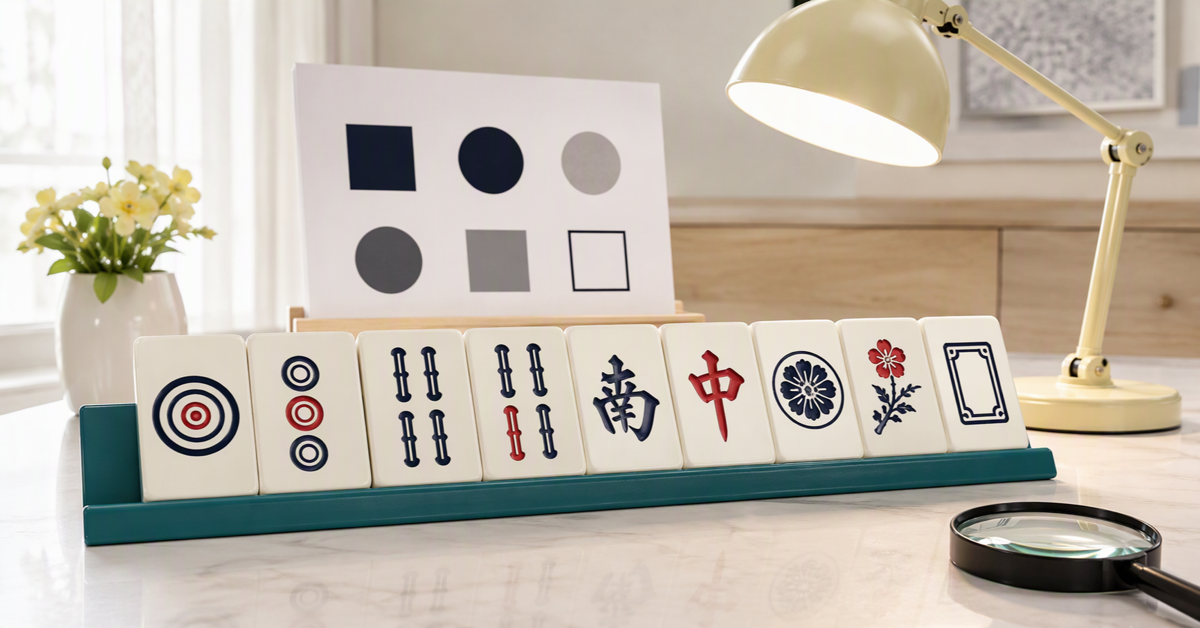
Choose a few potentially confusing tiles: a crowded numbered face, a stylized one-Bam, and a dragon design. Look at them under the light normally used for play. Move them from the rack to the center of the table. A face that is clear close up may be harder to recognize among discards.
Glare is worth checking without making assumptions about the material. Tilt a sample slightly and watch whether a reflection crosses the symbol. If it does, try the actual lamp position before deciding that a different tile size will solve the problem. Sometimes the issue is lighting, not dimensions.
When someone in the group needs larger markings, ask that person to compare the options. Do not use age as a substitute for a preference. One player may prioritize a larger number; another may prefer a lighter, less bulky tile that is easier to rearrange.
Make a paper footprint before replacing a whole set
Draw the proposed face dimensions on paper. Repeat the width across a row representing your usual hand. This will not tell you how the tiles feel, but it can reveal a surprisingly long row before you order.
Set the paper beside your rack and inside the available case space. Label it clearly as a size mock-up. Do not use it to judge symbol legibility unless the printed image is also at verified actual size; an enlarged website screenshot defeats the purpose.
For a purchase involving both tiles and racks, request confirmation of the pair together. For a tile-only purchase, list every accessory you want to keep. A slightly larger tile may be comfortable in the hand yet require different storage trays. That cost belongs in the buying decision too.
When a measurement looks right but the fit is wrong
| What happens | Check next | Avoid this assumption |
|---|---|---|
| The row feels cramped | Usable rack length and your preferred grouping gaps | That outside rack length equals usable space |
| Symbols disappear behind the lip | Lip height, support angle, and placement of the artwork | That a taller tile always has larger print |
| Tiles tilt or rock | Channel shape and the way the tile rests | That adding pressure will make a poor fit acceptable |
| The case will not close easily | Tray depth, padding, and packed orientation | That outside case dimensions describe its compartments |
| Stacked tiles feel uneven | Individual dimensions and damaged edges | That matching width proves all dimensions match |
If a new piece needs force to fit, stop. Do not file a rack or sand a tile as the first remedy. Photograph the problem and compare the written measurements with the delivered items. Altering them can complicate a return and create a different problem without resolving the original mismatch.
Ask for a dimensioned product answer
JOKKOL's green-back tiles with Jokers and pink-back tiles with Jokers offer different visual starting points. Their appearance alone does not establish a specific mahjong tile size.
Send JOKKOL a fit question with the model link, the three tile dimensions you need, your rack measurements, and a clear photograph. Ask which values are confirmed for the current model. Company background is available on the JOKKOL about page, while the general set-buying guide covers the other purchase checks.
Finally, remember that equipment dimensions and game rules answer different questions. A comfortable fit does not establish the correct tile inventory. Use the National Mah Jongg League to identify the American format and confirm inventory separately with the seller.
Quick measurement questions
Is there one standard American mahjong tile size?
Do not rely on the word "standard" as a complete specification. Ask the seller for height, width, and thickness for the exact model. The point of a dimensioned answer is to remove ambiguity, regardless of the marketing label used.
Which dimension matters most for a rack?
All three can matter. Width affects the length of the row, thickness affects how the tile sits, and height interacts with the lip and support angle. Test the combination rather than selecting one number in isolation.
Can I measure from a website photograph?
Not reliably without a verified scale and suitable camera angle. Perspective can distort the apparent proportions. Request a photograph showing the tile beside a ruler, with the measurement orientation stated, or obtain a sample when practical.
Are larger tiles easier for beginners?
They may suit some players, but large dimensions alone do not establish readability or comfort. Compare the size of the actual markings, the weight and handling, and the available rack space. A hands-on comparison is more informative than a size label.
What should I keep after buying?
Keep the confirmed specification, model name, and a few clear photos with the order record. They will help if you later need a new rack, case, or replacement tile. Record the delivered measurements too if fit is particularly close.
Mahjong tile size becomes useful when it is tied to a real task: reading a face, arranging a hand, or closing a case. Measure those tasks once and you can compare products with much less guesswork.